By Peter Rao ’24
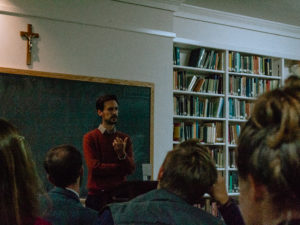 On Friday, October 21, 2022, Thomas More College welcomed to campus Max Becher, independent farmer and founder of the Catholic Agrarian, an online resource for those called to the agricultural charism.
The evening began with a family-style dinner, where students who are interested in farming after graduation had the opportunity to speak with Mr. Becher and his wife, Deidre. Following dinner, Mr. Becher spoke generally to the student body about agrarian life. In his lecture entitled “The Agrarian Life in Catholic Social Teaching,” Mr. Becher emphasized the Church’s stance on the dignity and necessity of agrarian life and the importance of farming as a vocation for the family. The agrarian lifestyle, being difficult to maintain on its own, is uniquely suited to family life. Mr. Becher concluded that family farms and homesteads should be highly encouraged, because farm work is not only necessary for the preservation of society, but also conducive to a productive culture and a beautiful home experience.
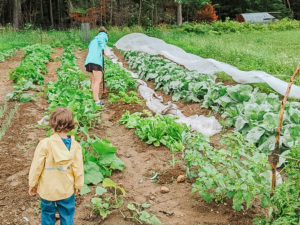 The Church, Mr. Becher continued, though supportive of agrarianism, has struggled at times in its attempts to preserve this lifestyle. The answer for families, therefore, is not to immediately flee to the fields, but rather to focus on making the home “more productive and less consumptive, more family-centered and less individualistic, and oriented to Christ in all it does.”
Annika DeMaster ’23, owner of Willow Haven Flowers in Pennsylvania, shared her comments on Mr. Becher’s visit. “What struck me was his overall emphasis on agrarian life as a vocation. There are advantages to thinking about it that way, because farming is very difficult and it’s extremely easy to just give up.” Having grown up in an agricultural community and being a farmer herself, Miss DeMaster’s view of the agrarian life is grounded in her personal experiences. “In farming,” she explained, “you learn a lot about how little you’re in control of things, which is why it can be frustrating as a career choice. Looking at farming as a vocation,” she continued, “helps put that frustration into perspective.” She also pointed out that self-sufficient farming is not a prerequisite for engaging in agrarian life, and that homesteading is a more viable option for most families. “In homesteading,” she explained, “you grow food for yourself, and you don’t make farming your career. Homesteading makes farming a lot more accessible for people, and as long as you have a little bit of space, anyone can do it.”
 Wynonah Hogan ’26 shared Miss DeMaster’s enthusiasm and expressed her appreciation for the College’s interest in hosting an event that focused on agrarian issues. “Farming is a huge part of who I am and who my family is,” she stated, “and it’s something that I think people should at least be aware of and be knowledgeable about, even if they are not directly involved in it.” Miss Hogan agreed with Mr. Becher’s comparison of agrarian life to the contemplative life. “I see farming as a contemplative lifestyle. When I’m at home, I spend a lot of time doing manual labor. It doesn’t demand as much mental energy as it does physical energy, but it’s a peaceful routine that allows me to pray and meditate while working in the garden or milking cows.”
Any farming endeavor, including small-scale homesteading, participates in agrarian life on some level. The Church itself, Mr. Becher clarified in his lecture, states that this lifestyle is uniquely suitable to the family and is thus a good practice for those who wish to transform the culture in their home. Mr. Becher’s visit offered a source of encouragement for those students interested in farming, whether as a career or as a different way of living out home and family life.

For further reading:
“An Apprenticeship in the Art of Being Human:” Interviews with Teaching Alumni