By Cassandra Taylor, Publications Assistant
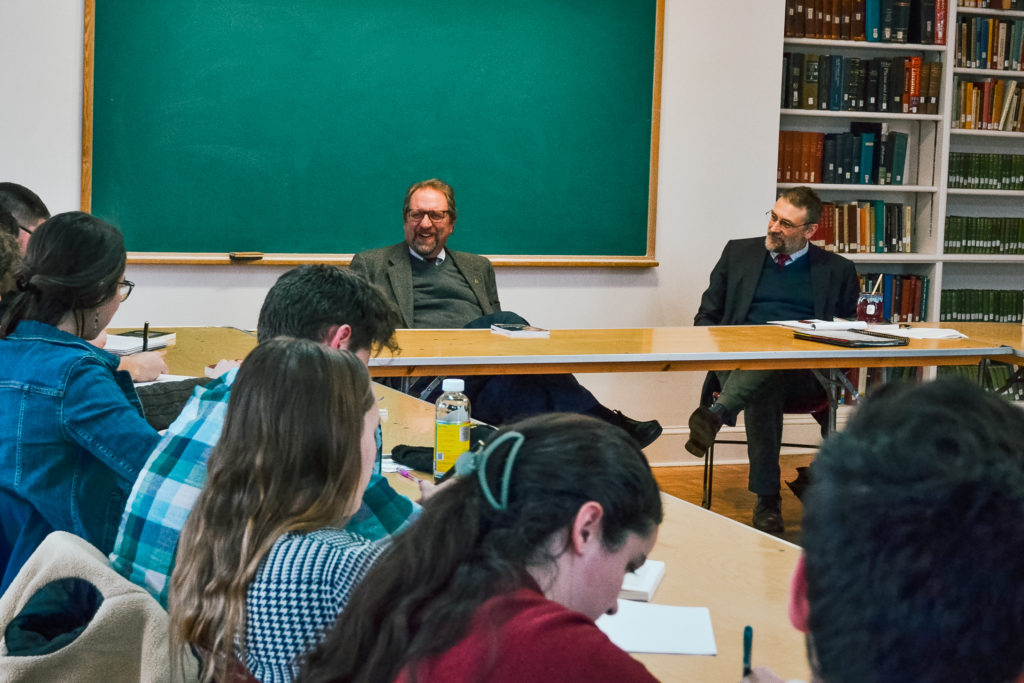
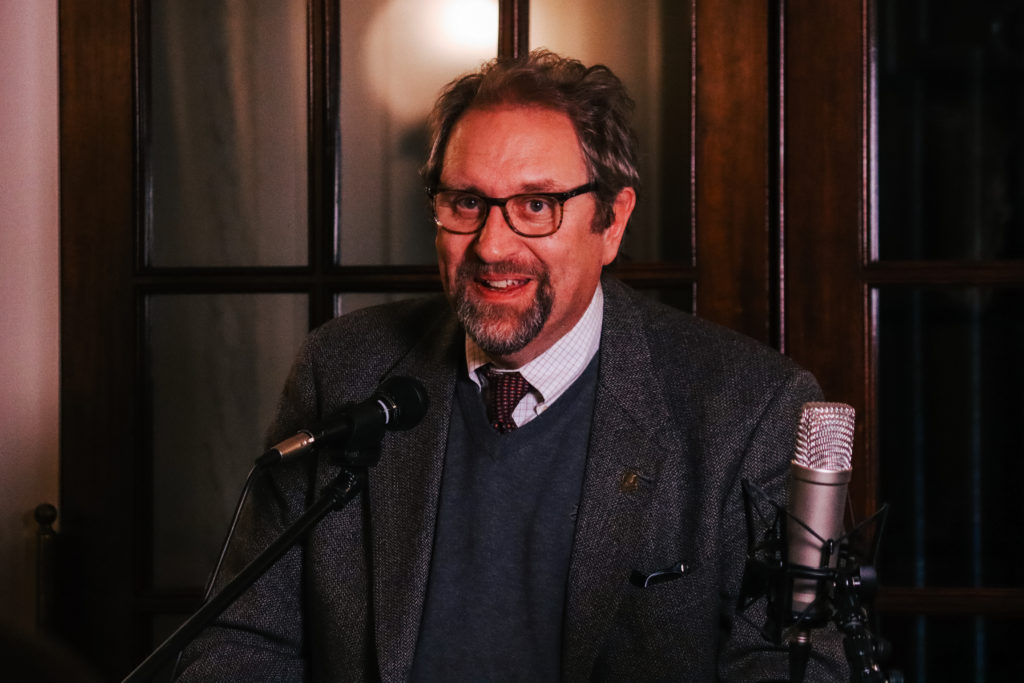
The Thomas More College community was thrilled to welcome Dale Ahlquist back to campus this semester. In addition to serving as president of the Society of G.K. Chesterton, Mr. Ahlquist is the co-founder of the Chesterton Academy, a classical high school in Hopkins, Minnesota, and the Chesterton Schools Network. Mr. Ahlquist gave the Commencement address at Thomas More College in 2017, where he received an honorary doctorate.
We sat down with Mr. Ahlquist to hear his thoughts on the state of education today, the importance of a joyful learning environment, and of course, all things Chesterton.
How did you first become interested in Chesterton? How did that lead to you founding a Chestertonian empire, including the Society of G.K. Chesterton, the Chesterton Academy, and the Chesterton Schools Network?
Like everybody else, I started reading Chesterton on my honeymoon. I had graduated from a highly-rated liberal arts college and was outraged when I realized that I had never been taught Chesterton, because here was a writer who far exceeded those I was assigned to read—who actually answered questions instead of just asking them! He was truly a complete thinker—there’s nothing narrow about him—and I just couldn’t get enough Chesterton. But this was a long time ago, when most of his books were out of print. The only way to find them—this was pre-Internet; even before the gas-powered Internet, which I also remember—was in used bookstores. You would go into one hoping that there would be a Chesterton book there, and the owner would say, “Oh, we can’t keep him on the shelf!” I think at that point only about six of his books were in print; you couldn’t find any of the others, and every time I got a hold of something, I was just thrilled to find it.
I ended up doing a master’s thesis on Chesterton, and I still thought I was the only one alive who was reading him, but it turns out there were at least a dozen others. There was a little conference being held in Milwaukee, so I attended it, and there were my people! They were all about thirty years older than me, so I represented the future to them. Those annual meetings in Milwaukee led to us starting the American Chesterton Society, and then we hosted the conference in the Twin Cities and created Gilbert! Magazine. In 2000, right as we were starting the Society and shortly after I became Catholic, I was invited to do a show on EWTN. That’s when the interest in Chesterton really started to explode, because of the exposure that we had.
The Chesterton Academy came a few years later, in 2008. Chesterton is the complete thinker that we want our students to be, so he was the perfect patron for our operation. The Chesterton Network started to take off right before COVID—we went from one school to about ten schools in the first ten years, and then in the last five years we probably added thirty schools. Next year, there will be sixty.
Why do you think the demand for this kind of classical education is increasing right now?
COVID exposed what bad shape our schools were in. Parents were watching what their kids were learning on the screen—and not just with public education, but private education too. They started realizing that most Catholic schools are just aping the public schools, there’s nothing distinctive about them. We had something that was really sensitive to what parents wanted, and we showed them how they could start their own school—it can be done! People were so thrilled to discover that they could do it themselves, and the Network is becoming such a force because they’re all like-minded people.
The “Six Hallmarks” of a Chesterton Academy are what unites the Network. One of those is “a joyful learning environment,” which is something we also have here at Thomas More College. Why do you think a joyful environment specifically is so important for actual learning to take place?
One of the keys is a line of Chesterton’s that we use to talk about the Chesterton schools, but it certainly would apply to Thomas More: “The one thing that is never taught by any chance in the atmosphere of public schools is this: that there is a whole truth of things, and that in knowing it and speaking it we are happy” (“The Boy,” All Things Considered). That’s what you’re studying: the whole truth, through literature, philosophy, and the humanities. But you’re also teaching them how to express what they have learned, because it’s “in knowing it and speaking it we are happy.” People are happy when they can express themselves, and if they’re expressing something good and true and beautiful, that makes them even happier!
What would you say to Juniors and Seniors at a Chesterton school who are thinking about going to a Great Books college?
A lot of our students are ready to specialize, to go out and study a trade, or nursing, or engineering. But there are some where we’re just lighting the spark, and they want to go deeper into the liberal arts, great literature, and classical learning. There are only a few schools that offer that, and I think Thomas More is a perfect fit for a Chesterton Academy graduate who wants to pursue it. With the Great Books, there will always be something you can draw water from—they’ll never go dry. And if they’ve read them once, that’s great, they have a head start—go on and read them again!
How would you describe the impact that institutions like the Chesterton Academy and Thomas More College are having on Catholic culture?
The only way we can change things is at a grassroots level—there are no top-down solutions. But if people start bringing what they’ve learned and the skills they’ve acquired to wherever they are, it will have an impact. For instance, at our school, we write our own plays! And that has a great ripple effect—everyone is a part of the creative act. And not only in the creative aspects or by going into the trades, but just by making new Catholic families. This is where a lot of people meet their spouses, and they’re going to have a great formation with which to start them.
Chesterton said that Thomas More “is more important at this moment than at any moment since his death, even perhaps the great moment of his dying; but he is not quite so important as he will be in about a hundred years’ time” (“A Turning Point in History”). Could you speak a little more to that?
Chesterton said that Thomas More is more important now than he was in his own lifetime—which is huge to think about, when you consider how important he was during his life! Thomas More not only defended the Faith against the state, but he also defended the family against the state. Chesterton knew in the 1930s that the family was going to be under attack, as well as the Faith—and of course, it shows how prophetic Chesterton was.
Besides both being laypeople—and having a sense of humor—what parallels do you see between Chesterton and Thomas More?
They were both amazingly broad in the subject matters they could write about. They both seemed to write about everything! Whether it was politics, or philosophy, or literature, or theology, they had a complete hold on whatever subject they touched.
What do you think is Chesterton’s single most important work?
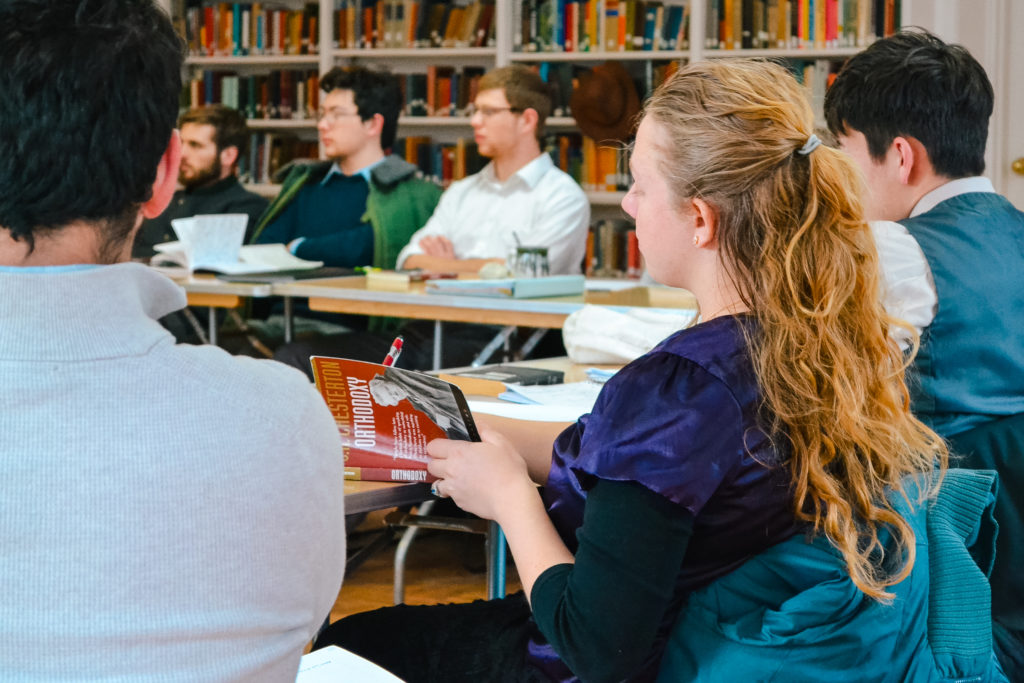
The danger of answering that question is that people will think, “Well, then that’s the only one I’m going to read.” And that would be so unfortunate! So, it’s really a dangerous question. However, the book that seems to be the trunk of the tree is Orthodoxy—but if that’s the only one you’re going to read, then you do have to read it over and over again, because like any classic, it will keep bearing fruit.
What are you working on now?
The work of the Chesterton Society continues! The schools have been taking up so much of our time and attention, but we are still pushing the importance of Chesterton as a writer and as a major literary figure, and we’re hoping to get his cause for sainthood opened. My own projects are publishing Gilbert! Magazine and working on two new books. One is an alternative autobiography of G.K. Chesterton; the other will address the oft-repeated criticism that Chesterton was anti-Semitic.
So, what is the process of writing an alternative autobiography?
Chesterton wrote an autobiography that was mostly about other people, but in his thousands of essays written for the newspapers, he drops a paragraph here, a paragraph there, about himself. There’s enough that I’ve been able to stitch together what will be the alternative autobiography of Chesterton.
What advice would you give to our Seniors who are heading out into the world?
The number-one piece of advice I’d give them is the same advice I gave to the graduating Seniors the year of my Commencement address at Thomas More College: read Chesterton.
These comments have been edited for length and clarity.