In a Catholic liberal arts education, students are called to learn from and love the works of man—especially those made for the glory of God. To that end, Thomas More College students spend a term in one of the world’s great cities—the seat of the universal Church and the heart of the Christian West. Four members of the Class of 2025 reflect on what life in the Eternal City this past semester taught them about Christian culture and being Catholic.
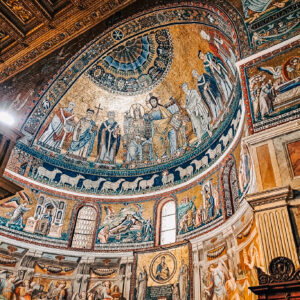 I do not believe it is possible to have a fruitful sojourn in Rome if one does not follow these two directives: be a pilgrim, and be a child. With a childlike pilgrim spirit, the traveler in the Eternal City has an opportunity to grow in virtue and wisdom; without this disposition, he is nothing but a drifter, floundering about in a milieu of history and culture with no ultimate goal.
Rome is wonderfully impractical. It is densely packed with the sort of beautiful things of which the thoroughly practical will never see the point. Those who have lost the receptivity of children are dead to the spirit that, over the ages, brought about the creation of these beautiful things. A childlike spirit recognizes, simply, that something beautiful is good, and is filled with wonder. Whether it has some practical purpose is wholly irrelevant. The purpose of wonderful things is to be wonderful.
Rome, moreover, is something not so much to be seen as to be imbibed. Its churches, monuments, and edifices are glorious unto themselves, but they cannot fully be appreciated apart from their particular place in the whole scheme of human existence. This is why the spirit of pilgrimage is invaluable in Rome: it gives the pilgrim spiritual perspective on everything, and thus helps him direct his experiences toward the eternal goods. The childlike pilgrim’s experience of what is called “culture” is both receptive and reflective; he learns from those that have come before him because he understands that they have wisdom to share as fellow pilgrims on this journey of life.
–Liam Beecher ’25
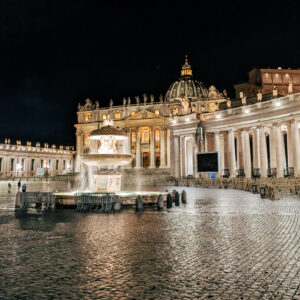 For an American, stepping into Rome is like walking into a living museum. The people here go about their lives, apparently oblivious to the enormous cultural weight of their city. They walk past ancient ruins, relics of the greatest saints, the most famous works of art, and they seem to take it all for granted. The residents of this city do not think of Rome as a museum, but their home. Generations upon generations of Romans have built and rebuilt Rome, ever-changing and yet the same.
The churches in Rome are living pieces of history. Any given church may have been built hundreds or even thousands of years ago; nothing is thrown away. Many of the oldest churches have been built from the spoils of some even more ancient Roman structure. The columns in many early churches were taken from temples and repurposed. At the same time, new additions are common. Often there is a mixture of styles and eras in their artwork and decoration. Early Roman mosaics are often found side-by-side with baroque frescoes and modern statues. These churches are not dusty old ruins of the forgotten past, but living, breathing places of worship.
The depth of the culture in Rome speaks to the richness of the Catholic faith. Experiencing the living Church in the heart of Christendom fills me with a sense of awe and reverence. The Faith is ingrained in the whole of the city, forming it over the centuries and allowing it to blossom. I hope that it will remain this way: constant and eternal, but more importantly, living.
–Margaret Six ’25
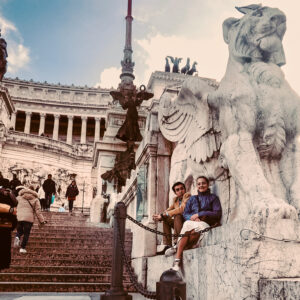 “Italians do things a certain way.” These words were repeated to me many times upon my arrival in Rome. Living here, I see the truth of this statement more each day. Whether it is a cappuccino and cornetto for breakfast, the cheerful and essential “ciao” at every meeting or parting, or even the witch’s brooms of the street cleaners, everything the Romans do is according to a very specific, though unspoken, code.
During our time here in Rome, we are challenged to learn these codes. By learning life according to a different approach, I have come to appreciate the thinking behind this way of doing things. Life in a community, especially in a city such as Rome, develops over many centuries, with some habits being very newly formed, some reaching beyond the memory of their source. Together they form a way of life that is distinctly Roman, but also deeply human, touched by the lives of generations. Living here has given me an understanding of the nature of culture: it is formed by men according to the universal laws of humanity, yet it is always shaped by the place where these men are, and by their attitudes toward that place and each other. The culture of Rome is established by the human hands that live there and that have lived there, and it is fundamentally flavored by the eternity of the city in which it resides.
–Marie Vyleta ’25
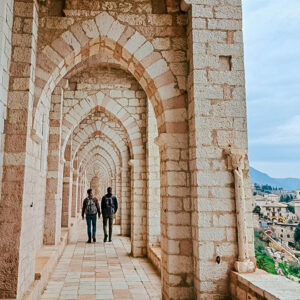 They say that young people need to “get out and see the world” and “broaden their worldview.” I always shrugged that kind of stuff off as typical rambly old-folk talk, probably because I didn’t know what it meant; but now I think I do know what it means, so I guess I owe it to the old folks to try to explain it through my own ramblings.
All of life seems to be a pilgrimage; but isn’t pilgrimage about walking around and basically being homeless? Yes, in some sense; but in the most real sense, no. The most real pilgrimage is the spiritual pilgrimage that we are all called to make, all the way from our disobedient Israelite beginnings to our (hopefully) Christ-like perfection in the end. That is the Christian life—a journey back to our creator, God.
So what has getting out and seeing the world done for me? Well, there’s something so real about physically going to new places and visiting different churches and towns that one hasn’t seen before. The physical movement makes the spiritual movement so tactual, so concrete, so alive. We’re not all called to make physical pilgrimages, but we are all called to make spiritual ones. In the end, the physical pilgrimage is so important because it reminds one of the spiritual journey. It has tremendously oriented me toward my end, in any case.
–Alexander Tapsak ’25
For further reading: