By Brendan McDonald ’25
When Hurricane Helene overcame North Carolina with torrential rainfall and catastrophic flooding in September 2024, Jacinta Yellico ’20 was with family in New York. A North Carolina native, she decided to return home to help with the relief efforts. Although the hurricane and its aftermath have receded from the headlines, the Western North Carolina community continues to come together, showing the resilience and beauty of the human spirit when working to help others.
Ms. Yellico shares more about her experience with us and invites all who are interested to learn more about Valley Strong Disaster Relief. She also lends her musical talents to “Valley Strong” by Seth Abel, which was written about the hurricane. “His words perfectly sum up the situation that was experienced by locals,” Ms. Yellico says. Listen here.
Could you describe the situation North Carolina has been facing? Hurricane damage stays in the news for a much shorter time than the areas recovering from it. What have outsiders missed?
If I had to sum up in a few words the situation that Western North Carolina has faced, it would be one filled with sorrow and unfathomable heartbreak but simultaneous hope and joy. I cannot speak for all who were affected by Hurricane Helene, but what I witnessed during my volunteer efforts was enough to give one optimism about the state of our world—especially in a time when it is easy to question the goodness left in society.
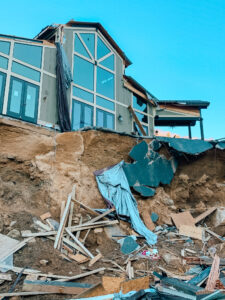
After Helene had dissipated, there was an estimated fifty-three billion dollars worth of destruction left in her wake in Western North Carolina alone. That gives an idea as to the scale of damage—not only to businesses and infrastructure, but more importantly to private property. In North Carolina, there were over two thousand landslides caused by the storm, many of which wiped out homes, outbuildings, and tragically, many lives.
The level of damage from this hurricane (particularly in communities that were mid- to lower-class to begin with) ensured that the homeless population rose by the thousands over the months following the storm.
If there is one thing I could emphasize regarding what is currently not a priority in the news, it would be the urgent demand for aid in the present. The first phase of storm relief is passed (search and rescue/recovery and meeting the critical need for basic supplies), but the rebuild stage has arrived, and that is getting far less coverage shared to the outside world than it needs. For the most part, anyone who was left homeless now has a place to stay, but their housing is temporary (tiny homes, campers, etc.), and there is a need for volunteers and donations to aid in the rebuilding of homes and communities.
What have been your volunteer efforts?
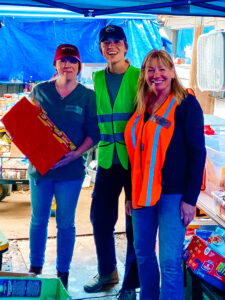
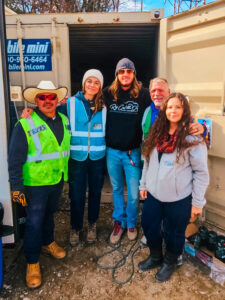
I worked for four months with a non-profit organization called Valley Strong Disaster Relief (VSDR) in Black Mountain, North Carolina. The distribution began in the kitchen of the founders, Ian and Jenalee Monley, and eventually relocated to Silverados, an outdoor music venue. It quickly grew to be one of the largest distribution sites in the area, providing any and all basic necessities—from food, to hygiene and baby supplies, to tools, to animal food, to chainsaw crews who would travel to assist someone on their property. It was operated entirely by volunteers—by individuals from all over the U.S. and numerous other countries—and run solely off donations. Many came to volunteer for a few days and ended up living onsite or nearby, working six days a week for months.
You can imagine the hope one finds when in the midst of an operation like VSDR. It was open for five months because of the generosity and charity of individuals. To have a distribution site be able to stay open because they have enough volunteers to operate it is heartwarming enough; but to have it run off donations entirely—with folks bringing in loads from out of state and mailing donations daily—is purely inspiring. That is what I refer to when I say that the situation began as one of tragedy, but it will end as something inspiring for anyone following along.
 Why did you decide to volunteer?
At first, it was a no-brainer for me to go volunteer because western North Carolina is home; but once I was in the middle of the efforts and seeing the situation firsthand, I realized that my reason for being there was a bit deeper. I would often talk to fellow volunteers about the kind of work we were doing. It might sound odd, but I believe that in the midst of what little I was doing for others—whether it was getting them a bag of dog food or trying to coordinate a saw crew to go to their house—they were doing something more for me. To hear someone who has lost everything speak about the gratitude they have and to see them smile awakens something in you. Perhaps it’s the realization that living for others is where true joy is; perhaps it’s something I don’t want to try to put into words, but I believe every fellow volunteer would agree that we left that place and realized we had grown and received something more valuable than the physical things we gave. It’s terrible that it took a disaster like Helene, but it brought people together in community, working toward something Godly, and that is definitely a silver lining.
For further reading:
Pursuing Truth, Goodness, and Beauty through Creativity: An Interview with Jacinta Yellico ’20
“Called to be Missionaries”: TMC Students and Alumni Undertake Mission Trip to Jamaica