By Brendan McDonald ’25

Jennifer He ’07 is the former president of the New England Library Association (NELA), a professional organization for librarians, and she is also the founder of WebGlow AI, a web design company. After graduating from Thomas More College, she earned a Master of Library Science from Simmons University in Boston, MA.
She took the time to describe why she chose Thomas More College, her experiences in library science and web design, and her interest in Artificial Intelligence.
How did you get involved with Artificial Intelligence (AI)? From an outsider’s perspective, it seems that AI came out of nowhere, but it’s been around for quite some time.
I really got involved with AI when I was at NELA. They have an Information Technology Section (ITS), which I chaired for three years. I regularly offered a session called “In the Know,” and we were basically teaching librarians about innovative technology. My background is in WordPress and web design, so when AI emerged, I had to talk about it.
Part of being the chair of ITS is that you’re supposed to put on a virtual conference every other year. I believe it was 2023 that I ran a conference, at which I also presented. And I decided to focus on innovative technologies and AI, because AI was a really popular subject at the time. I’ll be honest, it was risky. When I put the call out for presentations, we got no responses. But then I just started reaching out to people in the field, people that I knew would be willing to talk about AI for librarians and would be affordable. Then, for one of my presentations, I talked about AI, focusing more on generative AI and how you can use its tools for library programs.
There’s actually been a lot of development in that area, because there’s a lot of pushback against AI from artists and librarians. There are a lot of copyright issues, ethical issues … there’s a lot of pushback. But one promising area is that there have been many tools developed that can help people with disabilities—anything from neurodiversity to mobility issues. That’s really exciting, because that’s the bread and butter of librarianship.
Librarians are fascinated by AI, and they’re thinking about it. It’s definitely a wave of the future, and I can certainly see hesitation there, where librarians are a little bit cautious. It’s typical of that industry, but it’s not my job to judge. It’s more my job to educate and show librarians what kind of cool tools are out there.
I did a series of four talks last year in the spring. It was really fun, but they were more for the general public. I enjoyed it, though, because the questions were very interesting, and I gained a better sense of how the general public views AI. There’s a lot of fear and trepidation around the technology; some of it, I think, is warranted—and then some of it is a little bit of media hype.
What are some questions people ask about AI?
So this woman asked me a question that really surprised me: “Is AI like a creature in a box?” That was really interesting, because what she meant was, Can it think on its own? Is it going to come out of my computer? It makes sense because there’s a lot of misinformation out there that AI is going to become a cognizant being, right? I tried to explain that you have to think of it more as a tool, like a calculator. It’s very dependent on a person to run it.
I think what deceives people is that AI is very good at imitating human tasks, but those tasks are extremely limited, and it’s not able at all to make decisions in the way that a person would. But what surprised me a lot about her question is that I could tell she truly believed that AI technology was at that level—of being almost like a person.
You use AI for web design, which was something of a revelation for me, because when most people hear AI, they think, “I type in a question, and it gives me an answer, saving me the trouble of sifting through Google results.” But how can AI design images, or even an entire website?
The truth is tricky because, although I use AI more and more in my workflow, I don’t predominantly use AI in my web design work. Part of that is that people are hiring me for my expertise and talent—they’re not hiring a robot. I am not at the point where I would build a website with AI. Additionally—and I’ve demoed this at different conferences—AI does not do a good job right now with really broad tasks, but does better with narrow tasks. If you were to go to an AI platform and say, “Create an entire presentation for me,” it’s going to do a really bare bones mock-up job, and you’re going to have to do tons of editing. I’m not saying that five years from now, it’s not going to get better. It will—and I think everyone knows that—but right now, it does a lot better with narrow tasks.
Online, if you’re scrolling Facebook, you can pick up on AI images. The AI image is, I think, a step up from regular stock photography. Many nonprofits and different organizations do not have the budget or time to have a photographer come and take pictures, so they often use stock photography. But stock photography isn’t the best, because there’s kind of a distance there.
What led you to go to Thomas More College?
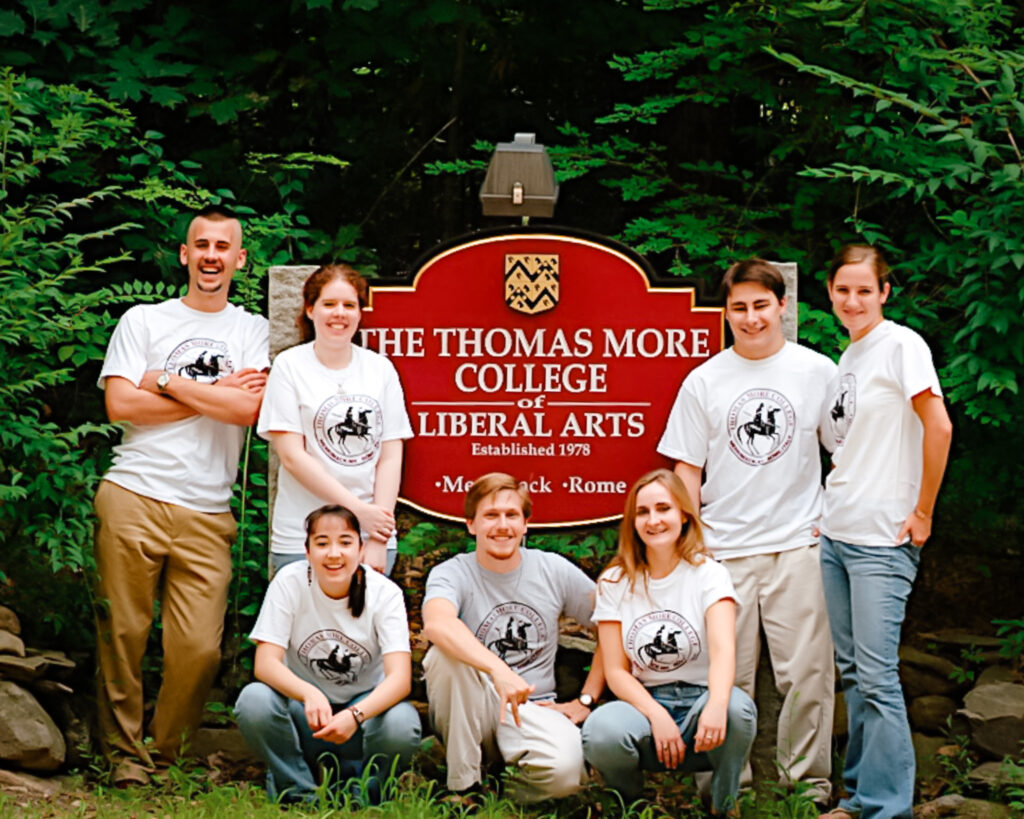
A whole bunch of things brought me to the College. The funny thing is, when I went on the tour, I instantly fell in love with it, but I was also really intimidated by it. I loved the little campus and felt at home there. It felt like family, right? And I loved the way it was designed with all of the common meals. They had a lot of social events, dances, the medieval banquet. And it just felt so special, but I think it was very intimidating for me because, at the time, there were only about eighty students in the whole school.
I also attended one of Dr. Sampo’s political science classes, but it was for the Juniors. I was so impressed because I couldn’t believe the amount of work that the students were doing, but on the other hand, it was daunting because I thought, “Oh my gosh, how can they be at that level?” But luckily, the admissions counselor at the time said, “Oh, don’t worry. You’ll get up to that point, you’ll work your way up, don’t be intimidated.” Then, when I moved on with my studies, I realized it really was true.
Later, when I went to graduate school, I appreciated that the professors invested so much in the students and the students gave a lot back, and unfortunately, that doesn’t always exist in other programs or other colleges. I just felt really grateful that I went to Thomas More. And then, of course, I was so impressed with the curriculum. There were definitely days when I felt overwhelmed by the work. I remember one day looking at the page count and knowing that I had to read 500 pages in one day. But now, as an adult, I can say it prepares you.
I even have people come to me sometimes in my career, and they’ll say, “Jennifer, why did you make such a bold move there? Why did you take that risk?” And the only thing I can say is, “I had a really great bachelor’s degree.” Other people are in awe of it, right? But for me, I legitimately have that preparation.
You are the former president of the New England Library Association (NELA) and the founder of WebGlow AI. What intermediate steps did you take between graduating and where you are now?
After I graduated from TMC, I planned to continue my studies. I wanted to become a professor of medieval literature. But there was an economic recession at the time, so I decided to become a freelance writer. I was also building WordPress websites and had a YouTube channel on the side. I really loved digital content creation and thought about the best way to combine my passion for academia with continuing to create content. I attended a session at Simmons University for the Master of Library Science program, where I learned about how library science is becoming more digital, with a focus on usability and web design. When I attended Simmons, I took traditional library science classes paired with technology courses such as programming, usability, web design, and database management.
I have the privilege to work on many amazing projects—for schools, libraries, colleges and universities, and all types of non-profit organizations. I’ve worked on usability and website projects for the Newton Free Library, Smith College Libraries, and the Astrophysics Data System at Harvard University.
My advice for being successful in a career is to never stop learning, keep working on the projects that you are passionate about, keep making professional connections, and keep perfecting whatever skills you possess.
These comments have been edited for length and clarity.
For further reading:
Jacinta Yellico ’20 Contributes to Hurricane Helene Disaster Relief
Buen Camino: TMC Pilgrims Walk the Ancient Road to St. James