By Jacinta Sigaud ’26
Thomas More College is blessed to have a rotating group of priests who come to our campus to celebrate daily Mass and provide spiritual direction. Our visiting chaplains include Benedictine and Carmelite monks as well as priests of the Anglican Ordinariate, the Fraternity of St. Peter, and, of course, the Dioceses of Manchester, Boston, and Burlington. One such diocesan priest, Fr. Rory Traynor—who is currently serving in Littleton, NH—has been a visiting chaplain at the College for nearly three years.
On November 16, 2025, Fr. Rory provided a lecture to the students entitled “Marriage, the Mass, and the Call to Conversion,” in which he discussed the interconnectedness of these three topics and the challenges and rewards involved in a life of radical faith.
Fr. Rory opened by citing Matthew 14, the passage in the Gospel that recounts St. Peter walking on water. “St. Peter is one of the most dynamic characters in all of Scripture,” Fr. Rory posited. “No one ever talks about the fact that he was the only one of the twelve to actually walk out to meet Jesus.” A figure of humility, St. Peter went through his own personal transformations again and again. “That is a man who is desirous of conversion,” Fr. Rory went on. “That is a man who is wise.” Fr. Rory encouraged the students to pay deep attention to Scripture, which TMC students study throughout their time at the College. “You’ve got to know your Bible. If you want to understand your love story, you’ve got to know the greatest love story of all time.” By being made in the image and likeness of God, Fr. Rory explained, we have been given what we need to live out our own love stories with God. “We have free will, an intellect, and the capacity to love God. We should use them.” Like Peter, we are called to set out across the unknown to encounter Christ.
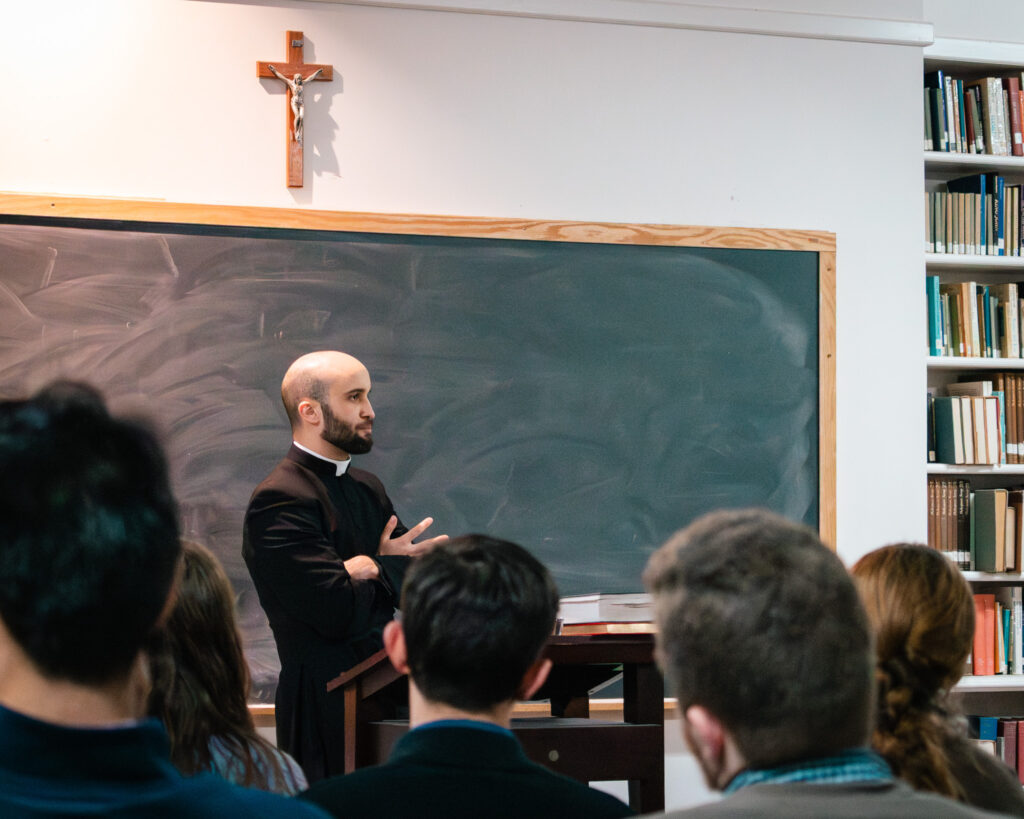
Continuing with Matthew 14, Fr. Rory reflected on the profound trust necessary to sustain our “marriage” with the Lord. “What Peter did was the equivalent of opening a hatch in an airplane. Because it was a storm, he was physically incapable of stepping out of the boat—he would have had to jump. That’s an insane thing to do.” That insane thing is no less than what is asked of each and every one of the faithful. Fr. Rory acknowledged how daunting this can seem. “Conversion is a scary word for Catholics,” he remarked. The temptation is to view conversion as “white-knuckling it better than everyone else” until we die. “Marriage is also a frightening prospect,” he continued. “There’s nothing more disputed than marriage in Catholicism today.” Conversion, marriage, and the Mass, Fr. Rory proposed, are inextricably connected. “You cannot understand any one of these topics without the other,” he explained. “You have to understand conversion in the light of marriage, you have to understand marriage in the light of the Mass, you have to understand the Mass in light of conversion.”
During Lent, we are asked to fulfill three obligations: prayer, fasting, and almsgiving. These three activities are meant to directly counterbalance the three primary sins in the Garden of Eden: pride, lust, and gluttony. “The foundation of conversion is growing away from your pride, your lust, and your gluttony,” Fr. Rory explained. This means moving away from what occurred in the Garden to grow closer to what God wants for us, which is “perfected in His son Jesus Christ.”
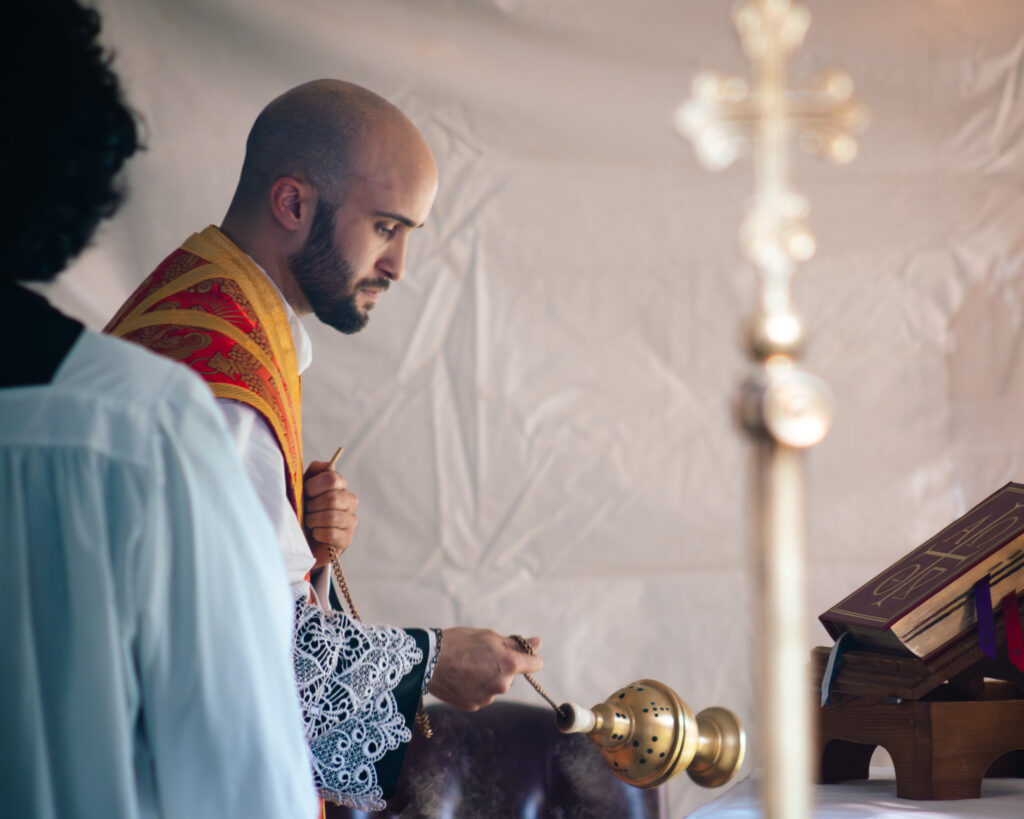
The first place we can begin to cast off these primary sins is the Mass. The Mass is an encounter with both the Cross and the Resurrection—a meeting with Christ Himself. “Marriage must be the same,” Fr. Rory insisted. Like the Mass, marriage “challenges everything about who you are.” In the Catholic tradition, the bride and groom give the sacrament to each other. Inherent in this reality is a demand from God to be faithful to each other just as He promised to be faithful to them. Just as with any sacrament, the grace from the sacrament of marriage remains after the words are spoken. “Marriage,” Fr. Rory stated, “is a sign of the Resurrection. Marriage is the lived reality of the Mass.”
Those called to married life are asked to offer their bodies as a living sacrifice to their spouses. Both the Mass and marriage compel individuals to become fully alive. “What Peter experienced on the water was recognizing that he’s inextricably married to Christ. He surrendered everything he understood, everything he believed about himself, everything he knew to be physically true in the world. In that one instant,” Fr. Rory continued, “Peter surrendered it all to Christ.” By walking on the water toward Christ, Peter implicitly stated: “My marriage is to Christ and to Christ alone.” We are called to the same union. “In order to get onto the path of conversion, you have to think of yourself as married to Christ,” said Fr. Rory. “He already knows all your sins.” Just as a husband and wife recognize each other’s faults and still choose each other, God always chooses us, despite knowing our unworthiness. “Marriage will call you out onto the water and will rob you of everything you thought you knew. It will turn your life upside down, challenge you, berate you, strip you down, beat you down, and make you into a better version of yourself.”
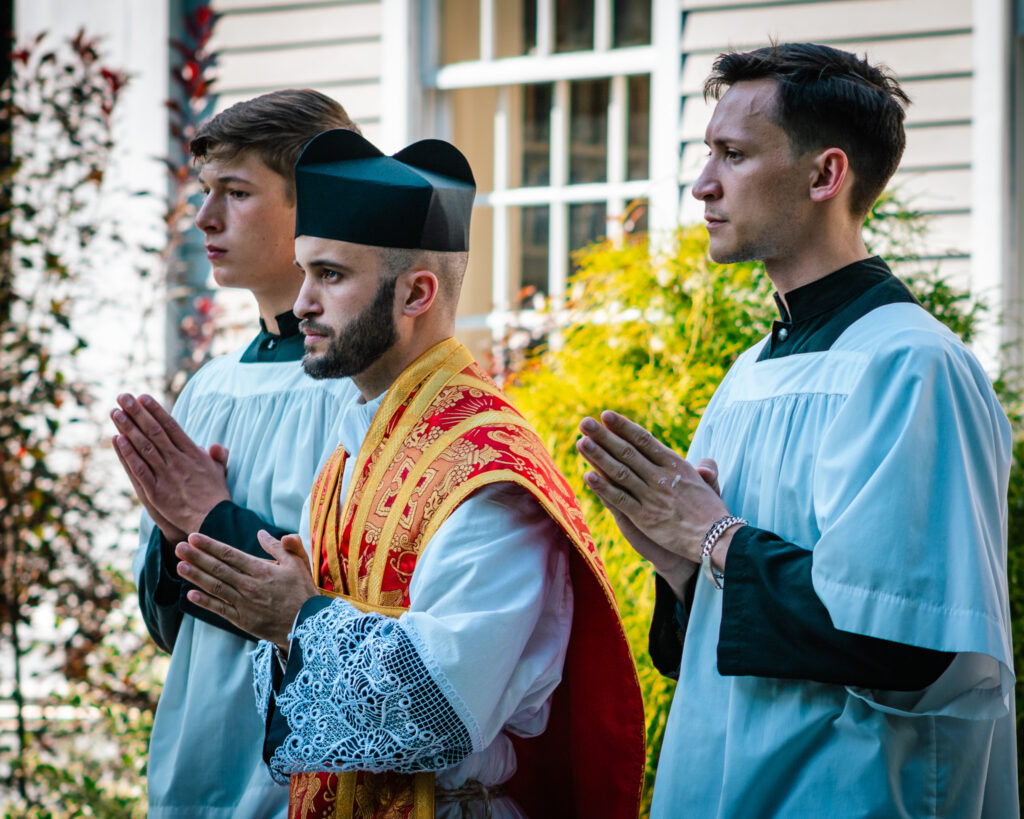
Fr. Rory concluded by reminding the students that, like any relationship, a marriage with Christ requires time and effort to maintain. “God is calling you to be fully alive. Next time you’re at Mass, remember: this is Christ reuniting with you in your marriage. He still chooses you.”
Image: Lavinia Fontana, The Wedding Feast at Cana [detail]. Courtesy the J. Paul Getty Museum
For further reading:
“A Schooling in the Heart of Jesus”: TMC’s Eucharistic Pilgrims