By Jacinta Sigaud ’26
One of the defining moments of a TMC student’s academic career is the defense of their Junior Project. After spending months reading and reflecting on their chosen work under the guidance of a faculty advisor, third-year students present their project before a faculty panel and their fellow students. This is an excellent opportunity to display the hard work they have dedicated to a project they are passionate about.
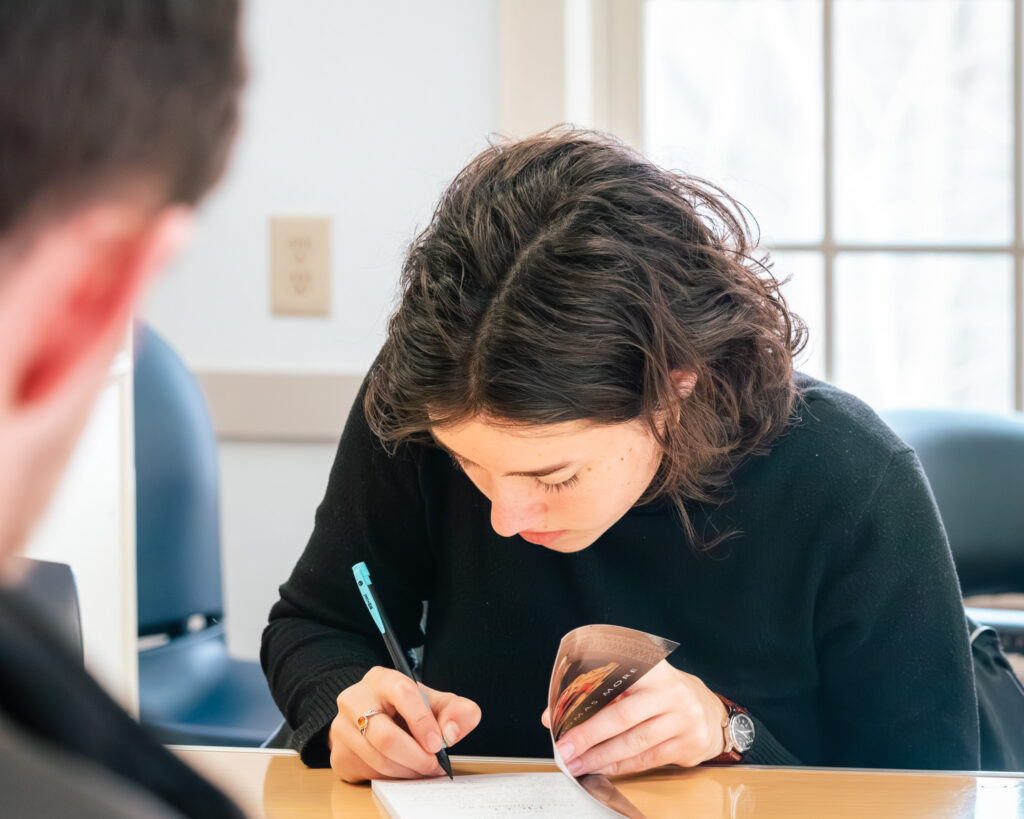
Elizabeth Fournier ’27 was both excited and intimidated at the prospect of defending her Junior Project. Discussing her chosen work, The Dream of the Rood, with her advisor, Teaching Fellow Dr. Amy Fahey, proved to be a rewarding experience. “Throughout the semester, I came to a greater understanding of the poem and its parts through her insight and guidance,” Miss Fournier stated, “but I still felt my lack of experience as the presentation drew closer. In the face of the rich and layered work of the poem and the panel of professors, what did I know?” Miss Fournier ultimately understood that the Junior Project is not meant to be an exhaustive analysis of a text. Rather than being “a test of the facts a student has memorized over the semester,” the Junior Project is “a test of what one has discovered—through the aid of their advisor and from their own meditations—through question and conversation.” Miss Fournier realized that the appropriate disposition when undertaking her Junior Project was one of humility. “I knew that there was much more I could learn about the poem, and that the panel of professors questioning me had years of wisdom to my few,” she explained. “Reading and conversing with Dr. Fahey deepened my understanding of the poem, and I had prepared my presentation—all I could do was enter into the defense with a sense of humility for what I did not know.”
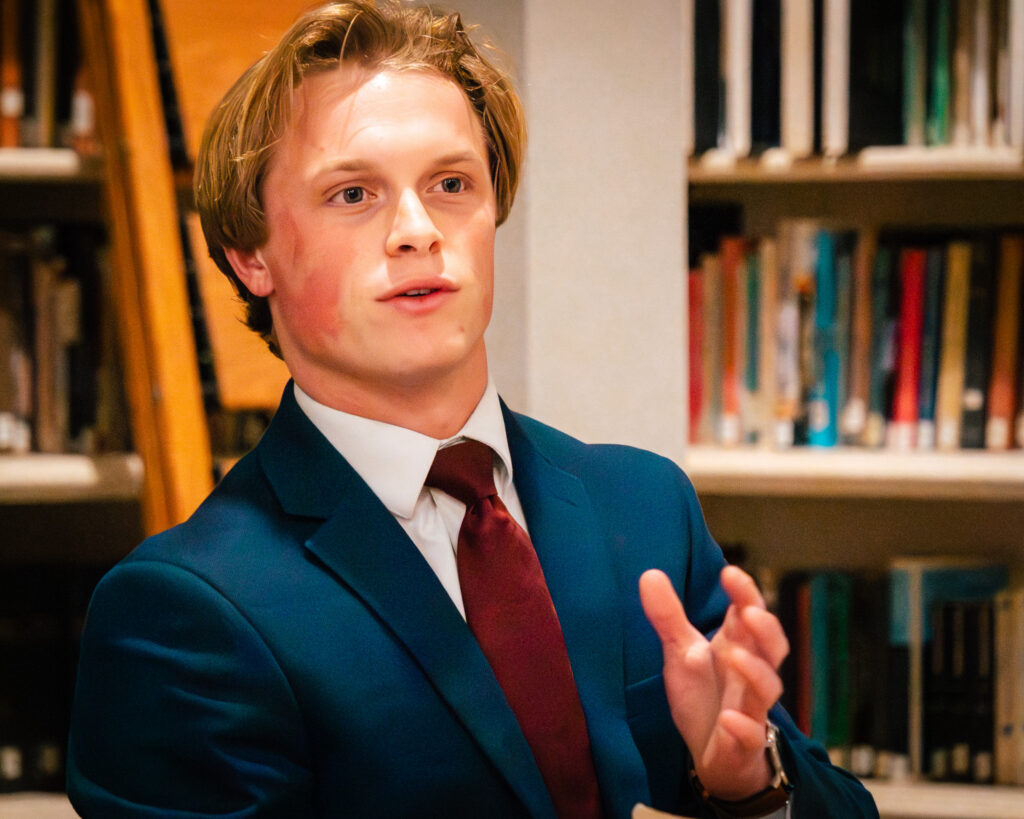
Jude Wassell ’27 decided to tackle Ernest Hemingway’s In Our Time for his Junior Project “because of its unique short story cycle form and the intriguing content of each story.” Setting aside time to prepare his presentation, in addition to the rest of his classwork, proved to be a challenge for Mr. Wassell throughout the semester. The Junior Project provides helpful practice for multi-tasking and time management, skills that serve students well in the future. “The most rewarding part of the whole process,” commented Mr. Wassell, “is the intimate way I have come to know the work. I had read it beforehand and of course enjoyed it thoroughly, but after months of reading, rereading, writing, and research, I have come to appreciate it even more.” Mr. Wassell continued, “I think the Junior Project is one of the most fascinating aspects of the curriculum. It is a test to see if you can dwell with a work and an author in a serious way and, after learning more about it, have a mature conversation with the professors. It’s proof that you have learned from your first two years how to read books well and articulate your thoughts in conversation.”
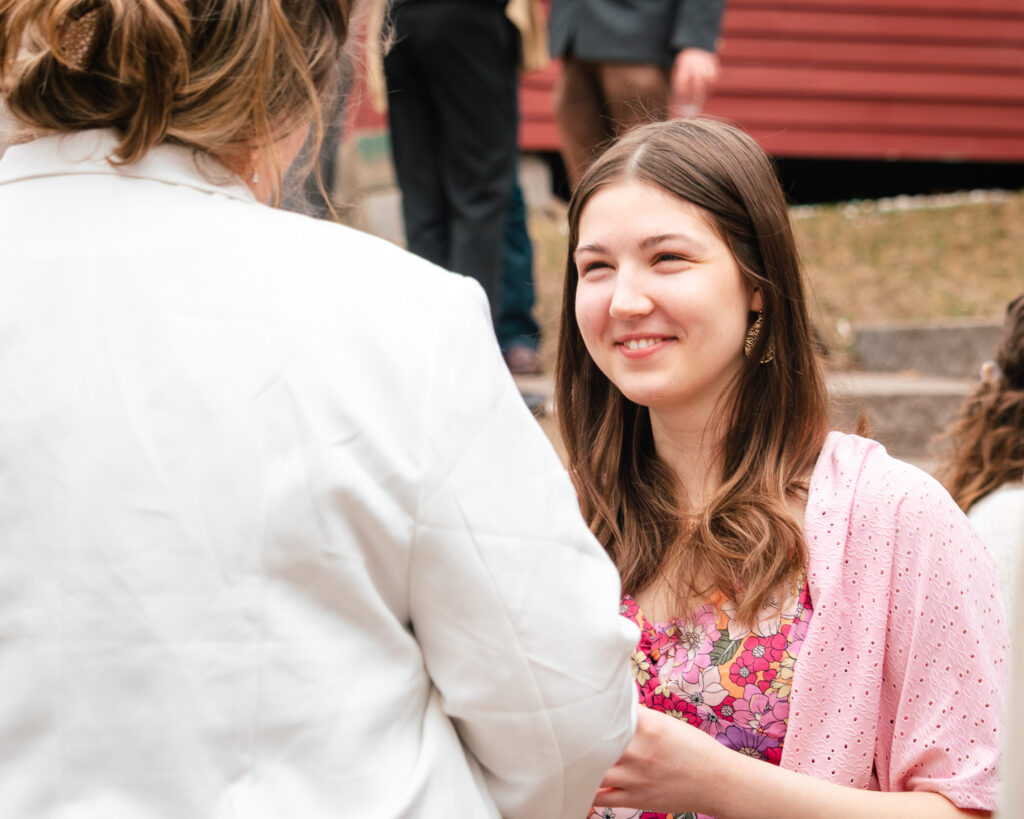
For Jeanine Engler ’27, the Junior Project was a chance to return to a freshman-year favorite: Virgil’s Aeneid. After reading the work with Teaching Fellow Dr. Matthew Edholm in Humanities II—a course which focuses on Roman and early Christian culture—Miss Engler realized that, due to the richness of the text, she was left with many unanswered questions. Two years later, with Dr. Edholm as her advisor, she delved deeper into the text that had so fascinated her. “Virgil constructs a completely interwoven narrative,” Miss Engler commented, “so the work must be studied as a whole, in order to begin recognizing all the angles Virgil is coming from.” The Junior Project, while a welcome opportunity for students to discuss a work they are passionate about, can also be a daunting task. “I think the biggest worry for the Junior Project is the intimidation of sitting and discussing the text for an hour with your professors,” Miss Engler remarked. “What gave me comfort was knowing how hard I had worked on my project and trusting that it would show.” The Junior Project’s challenging aspects make it a rewarding accomplishment when completed. “I understand now why the Junior Project is part of the curriculum, as a way for the students to be passionate about something of their own choice and see the fruit of all that they’ve done here so far,” Miss Engler commented. The Junior Project gives students “a feeling of accomplishment and zeal to continue on.”

Also returning to a text from freshman year was Samuel Matt ’27, who chose to focus on the Timaeus, a Platonic dialogue that presents a cosmological vision of the universe’s creation. “When I read the Timaeus for Mr. Mitchell’s Euclid class in the spring of my freshman year, Plato’s beautiful descriptions of the cosmos leapt out at me,” Mr. Matt explained. “After taking the text up again, poring over its pages, and pondering it more closely for my Junior Project, I have come to see and to love the ways in which the singularity of Plato’s mind has opened up pathways in the hearts of so many to seek the same indefatigable wisdom he was after.” The entire process—from preparing the presentation, to his discussion with the professors—was an opportunity for Mr. Matt to cultivate an awareness of both his own limited knowledge and his capacity for intellectual growth. “I came out of the discussion desiring exactness of thought, clarification of my own thoughts with those wiser than me, and a dual dose of patience and persistence with an eye toward my further education. Throughout the journey of my preparation, I overcame the constricting, suffocating fear of being wrong,” Mr. Matt explained. “I now have a greater sense of what ‘intellectual freedom’ means.”

Fall Session:
Christopher Cain: Aesop’s Fables
Andre Carty: First and Second Apologies of St. Justin Martyr
Jacqueline Clark: The Letters of Abelard and Heloise
Jeanine Engler: Virgil’s Aeneid
Elizabeth Fournier: The Dream of the Rood
Luke Stanger: Cicero’s De Officiis
Jude Wassell: In Our Time by Ernest Hemingway
Spring Session:
Thomas Arias: Leisure, the Basis of Culture by Josef Pieper
Owen Barber: Poetic Diction by Owen Barfield
Michael Davignon: The Brothers Karamazov by Fyodor Dostoyevsky
Alexander Gay: Thucydides’s The Peloponnesian War
James Greydanus: The Abolition of Man by C.S. Lewis
Valerie Hurth: Kristin Lavransdatter by Sigrid Undset
Gavin LeClair: Phenomenology of Spirit by Georg Wilhelm Friedrich Hegel
Samuel Matt: Plato’s Timaeus
Anne Metily: Book of Job
Greta Schnake: Gunnar’s Daughter by Sigrid Undset
Mary Ingrid Schnake: Helena by Evelyn Waugh
Marianne Shea: My Antonia by Willa Cather
Oliver Veevers-Carter: Beowulf
For further reading:
Tilting at Titles: The Class of 2026 Defends Junior Projects